Friday, August 29, 2008

no gunns blazing

ABC News Radio this morning reported that Gunns is having trouble finding financial backers for its proposed pulp mill in Tasmania's Tamar valley, following the withdrawal of the ANZ bank earlier this year. Gunns apparently admitted that the pulp mill might never be built. One can only hope!

The Wilderness Society is continuing to raise awareness of the significance of the region and the detrimental effects the mill would have on the environment. According to the radio report, there is concern that the forestry industry in the region might collapse if the mill isn't built. How long could the industry log the region before its resources were exhausted and the industry collapsed in the region anyway? Long enough for the loggers' children to have trees to fell?

Its interesting how the Wilderness Society is now approaching the need for conservation of these forests. With climate change on the agenda the forests' utility as a Carbon sink is coming to the fore. This new angle of attack would have had no impact 10 years ago. Times have changed.

The Ecologies Project - Monash Uni. Museum of Art

17 September 2008 - 22 November 2008

Opening function: Saturday 20 September 2008, 2pm
Curators: Geraldine Barlow and Dr Kyla McFarlane

Pre-opening curator's talk
Saturday 20 September at 1.30pm

Opening function
Saturday 20 September at 2.00pm
Monash University Museum of Art, Clayton Campus
With opening remarks at 2:45pm
by Professorial Fellow John Thwaites, Chairman of the Monash Sustainability Institute, and Former Deputy Victorian Premier and Minister for Environment, Water and Climate Change

What is this project that we are now undertaking, as we globally seek a new balance with the ecological systems that sustain us?

Will endgame, apocalyptic visions drive change, or can our wonder in the natural world inspire the creation of a brighter future?

Artists have long drawn inspiration from nature, as well as being advocates for a sustainable relationship between humanity and the environment. Now that a need for change has become broadly accepted, what role for art? Even with this accepted impetus to action, the particular paths we might take are unclear. It is an exciting and unsettling time as we sit between the darkest and most hopeful of futures. We must grapple with a myriad of abstract and interconnected systems, economic, environmental, social and philosophical. At this moment in time, art offers a lens through which we can examine the world as well as a kind of metaphorical thinking that can sharpen our perception of the relation between these complex parts and their impact on a dynamic whole. The Ecologies Project includes work by 40 artists exploring issues of sustainability, climate change and the idea of ecology as both form and metaphor.

LAURENCE ABERHART | LAUREN BERKOWITZ | CHRIS BOND | ANGELA BRENNAN | PAUL BUWANG BUWANG | JANET BURCHILL AND JENNIFER McCAMLEY | JOYCE CAMPBELL | MIKALA DWYER | MICHAEL CORRIDORE | PETER DOMBROVSKIS | BRODIE ELLIS | ANNA EPHRAIM | GALI YALKARRIWUY GURRUWIWI | ANDREW HAZEWINKEL | SUSAN JACOBS | ASH KEATING | NICK MANGAN | DHUWARRWARR MARIKA | MANDY MARTIN | VERA MÖLLER | JAMES MORRISON | ANNE NOBLE | HENRY NUPURRA | RAQUEL ORMELLA | FIONA PARDINGTON | LUKE PITHER | ADAM PYETT | STUART RINGHOLT | EWEN ROSS | SANDRA SELIG | ANDREW SINCLAIR | EILEEN YARITJA STEVENS | LISA STEWART | RICKY SWALLOW | CHRISTIAN THOMPSON | MICHELLE USSHER | ROHAN WEALLEANS | ROY WIGGAN | JOHN WOLSELEY

Thursday, August 28, 2008

mind the gap: animated data

Hans Rosling, professor of global health at Sweden’s Karolinska Institute, gives an animated talk employing animated data on the TED website. In addition to the demonstration of his very cute data-visualisation software, Trendalyzer, the talk discusses the relationships between a nation's child mortality rates, GDP, family size and various other values. Some surprising (to me anyway) trends from the last 40 years of worldwide development are revealed. In particular, there does seem to be a global upturn in health as measured by these simple statistics. The spread of wealth seems to be flattening across the nations, and the health and wealth of the "developing world" is approaching that of the West. However when viewing statistics within each country, similar trends are not necessarily present, the divide between haves and have-nots remains.

More information on the software and associated projects is available from Rosling's not-for-profit organisation, Gapminder. A quick play reveals Australia is up there with Japan and Switzerland amongst the very top few nations for life expectancy. As individuals we don't quite have the material wealth of some other countries (e.g. Luxembourg!), but we seem to live a couple of years longer. We also emit a lot of CO2. I wonder if data is available to compare the number of stadia, museums and art galleries, theatres and concert halls per capita between countries. Just curious.

Tuesday, August 26, 2008

bicycle vibrations - james angus

By a strange, circuitous route, I just discovered this exhibition record at Roslyn Oxley galleries, Bicycles 2007 by Australian artist James Angus.

...I'm yet to see one of these lovely bikes in the flesh (there is an orange machine with drop-bars at the Ian Potter gallery for the Basil-Sellers prize) but if the photographs are anything to go by they are marvelous sculptures. Not one bicycle, but three, or two? Or is it one bicycle that has been abused by a few too many road vibrations? Perhaps it is shaking its soul free. Perhaps I have had too much to drink. Its hard to tell what these feel like from photographs alone so I will wait until I visit the exhibition before I write anything much about the work.

I wonder at the artist's choice of seat cluster. By attaching the seat-stays so low on the seat tube the elegance of the traditional dual-triangle frame is compromised. This is especially noticeable when contrasted against the smooth lines of the drop bars on the sculpture entered for the Sellers prize. I can only assume the choice is a deliberate attempt to sculpturally dislocate the machine. What lively and seductive sculptures! I wonder if I could get a ride on one? :-)

Monday, August 25, 2008

middle-class ruins

My favourite suburban architecture is the "middle-class ruin". There are a few gems around although they are becoming scarce as developers take hold. Once lovely weather-board homes have been left to fade in middle-class leafy streets. Their elderly occupants do likewise as the lawn threatens to swallow them and their decrepit, unpainted coffins whole.

Not far from my house one of these is piled under tons of scrap metal, old fence posts and palings, rusty car doors and broken garden furniture. If the house wasn't positioned prominently on a slope overlooking the street, the entire block would look like a junk yard. Instead the house, its balcony crammed to the rafters with detritus, displays its face to the middle-class street. It defies the trim lawns and designer landscape gardens, the ecologically sound architecture with four-wheel drive tanks parked in the driveways to lodge a complaint.

In the wilderness between my home and work a derelict building site for a dream home lies frozen at the moment the money ran out. Neatly stacked timber and bricks are succumbing to dandelions, uncut grass and ivy. Kids have smashed the windowpanes and scrawled tags on the rendered walls. Bright fingers of electrical wiring emerge from a hole in the eaves over the front door. Are they clutching at the space where a light fitting was supposed to be?

An abandoned swimming pool. Its blue paint is cracking and peeling. Slimy black sludge has collected at the deep end. A few straggly weeds are sprouting here too. In spring they'll flower into pretty, white daisies. Is that the corpse of a possum or a cat down there?

There are places even in Melbourne's suburban sprawl where the imagination can roam free.

Saturday, August 23, 2008

library of dust

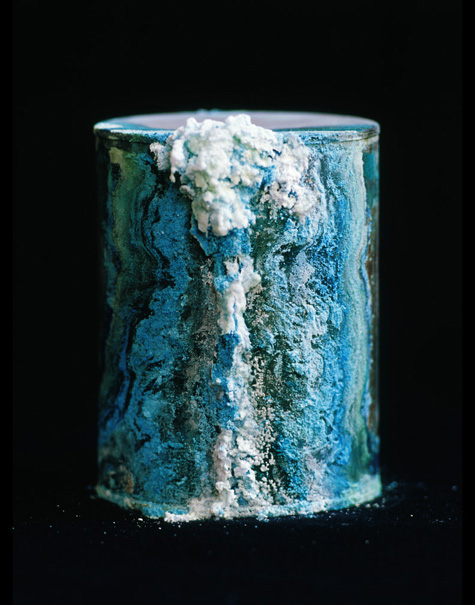
In keeping with the themes of biology and decay, I stumbled on a post (on BLDG BLOG) about a book, Library of Dust. The book is a collection of photographs of unclaimed, cremated human remains from a psychiatric hospital — compacted and tinned humans, stored like corn and beans on a supermarket shelf!

Unlike the bones of the catacombs beneath Paris or the ossuary of Sedlec, the human form of the remains has been completely obliterated. Whilst the bones of Paris and Sedlec have been jumbled, these human remains have been kept separate from one another. Each can of ashes leaves its unique, visible mark on the world through the patterns of corrosion on its surface. The ex-patients may have been tinned and stacked, but they regain a unique identity in a most unlikely way. Library of Dust is a strange, visually arresting and thought provoking record of people past.

Image: From Library of Dust by David Maisel, published by Chronicle Books

athletics, Muybridge and the red queen

Shot type 1: Its over 100 years since Muybridge's death and I find myself glued to the television to appreciate an idea that originated with him. The Olympic Games have been two weeks of the most beautiful pictures of human physiology I have ever seen. My favourite shot is certainly the slow motion tracking camera that follows alongside a sprint or gymnastic tumble.
I first consciously appreciated this shot as the final sprint in the Tour de France exploded along the Champs Elysées a few years ago. The lens does not distort the perspective as it would when using a distant telephoto. The angle remains fixed. The background tears past at a terrifying rate, the cyclists are trapped in the frame like the Red Queen, legs ablaze, faces straining, backs arched before a final throw for the line. And the whole thing can be repeated at a fraction of race pace so that you can take it all in: muscles ripple, sweat collects on noses and jaws before gracefully lifting from the grimacing face to glide away and off-screen.
The same shot applied to athletics, especially the 100m sprint, reveals the wealth of detail Muybridge captured. The form of a top class runner is a gorgeous sight that can best be appreciated in this slow motion tracking shot. The technique allows the repetition of the cycle to be appreciated. For just short of fifty paces the best runners maintain a fluidity that belies the effort it requires. In less than 10 seconds the race is all over, the medals are decided, the athletes are ecstatic and bounce around, or they are shattered and collapse in tears on the track. Years of effort to produce 10 seconds of glorious physiological poetry. Thanks, your effort is appreciated... especially by the airlines, fast-food chains. vehicle manufacturers and banks whose advertisements I had to endure... but also by the millions of other crazy people like me who tuned in to admire technology's view of the body in motion.

Shot type 2: The photo-finish is also a fascinating piece of work. In this, slices of the athletes as they cross the line are compiled into a single image with a timing scale marked along the image's edge. Lines placed on the image at the point where an athlete's chest (or front bicycle wheel) first touch the line may then be read off the timing scale to determine their time. The distorted forms of the athletes look less than elegant, but the image is a great way to reveal a winner.